Fabrication

Planning structural steel erection around a live plant

Erecting steel in an operating facility is not the same job as erecting it on a greenfield site. The constraints are the programme.
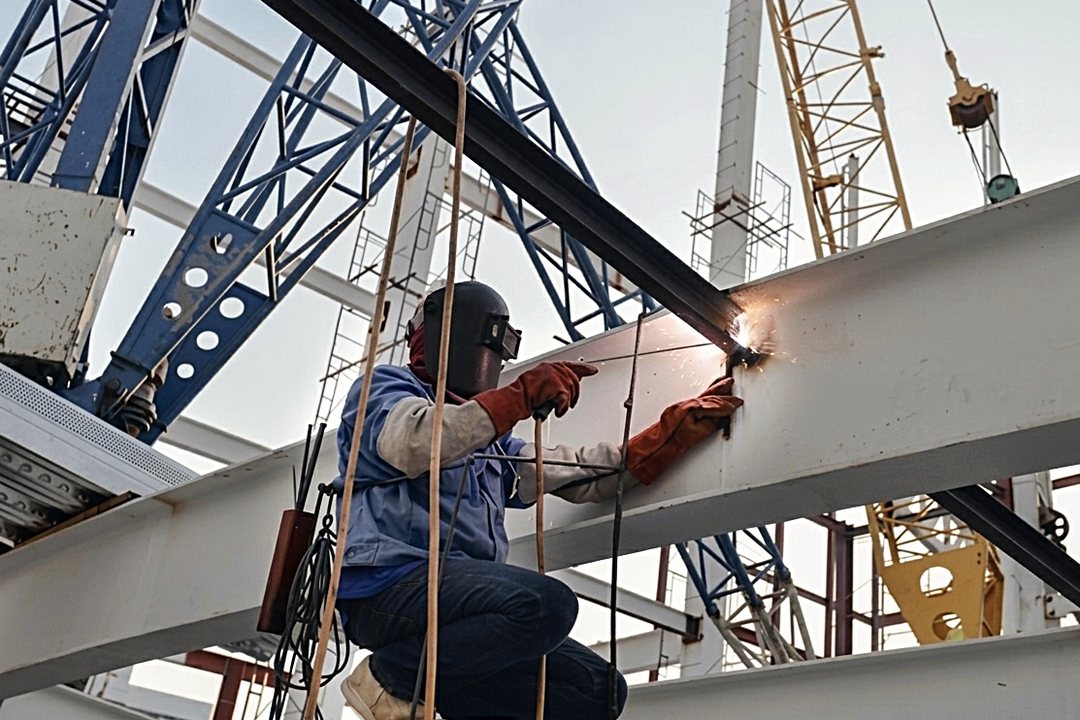
Welder working on a structural steel beam at height with a crane in the background

Most industrial steelwork does not go up on an empty site. It goes into a facility that is running, where the plant's operations take priority over the construction programme — as they should.

That single fact changes how the work is planned.

Start from the constraints, not the sequence#

On a greenfield site you plan the erection sequence and then arrange access around it. In a live plant you do the opposite: establish what you are permitted to do, when, and then find a sequence that fits.

The constraints that usually govern:

Crane position and radius. The convenient standing position is frequently over a live line, an underground service, or an access route that cannot be closed. Confirm ground bearing and buried services before assuming a position is available.

Lift paths over live plant. Suspending a load over operating equipment may be prohibited outright. If so, the sequence has to be built from the lifts that are permitted.

Permits and isolations. Hot work needs a permit, and a permit needs an issuer who is available. In practice this often reduces an eight-hour shift to five productive hours. Plan on the real figure.

Simultaneous operations. Other contractors are working too. Scaffold going up next to your lift zone can stop the lift.

Prefabricate as much as possible#

Every hour of work moved from site to shop is an hour removed from permit constraints, weather, working at height and the operating envelope.

Assemble in the largest sections the crane and access will genuinely take. Complete surface preparation and coating in the shop. Trial-fit connections before delivery — discovering a misalignment at height, mid-permit, is the most expensive way to find it.

The limit is usually transport and lift capacity, not fabrication.

Design connections for site conditions#

A connection detailed for the shop and a connection detailed for erection at height in a congested area are not the same detail.

Bolted connections beat welded ones on site wherever the design allows: no hot work permit, no isolation, no fire watch, no weather sensitivity. Where welding is unavoidable, position it for reasonable access — a weld that requires an awkward posture will be slower and of lower quality, whatever the procedure says.

Provide adjustment. Slotted holes and shim allowances absorb the tolerance stack-up that always exists between an existing structure and new steel.

Sequence for stability at every stage#

A structure that is stable when complete may not be stable halfway through. Temporary bracing is part of the design, not an afterthought — and the sequence must be such that no partially erected frame relies on a member that has not been installed yet.

Write the sequence down and put it on the drawing. A sequence held only in the site engineer's head disappears the day they are called elsewhere.

Plan the interfaces#

Steelwork is almost never the last trade. Insulation, cladding, electrical and instrumentation all follow.

Decide before erection where cable-tray supports, insulation supports and equipment brackets go, and weld them in the shop. Retrofitting them means hot work on erected steel inside a live plant — the most constrained, most expensive place to do it.

A workable pre-mobilisation checklist#

  • Crane positions confirmed against ground bearing and buried services
  • Lift paths agreed with the operating team, in writing
  • Permit process understood, including who issues and when
  • Realistic productive hours per shift agreed with the client
  • Erection sequence documented, with temporary bracing shown
  • Follow-on trades' fixings included in shop fabrication
  • Access and exclusion zones agreed with other contractors on site

None of it is exotic. It is simply the difference between a programme that holds and one that does not.

We fabricate and erect structural steel in operating facilities. Discuss your project.

Keep reading

All insights