Insulation

Hot, cold and cryogenic: choosing the right insulation system

The three insulation duties fail in completely different ways. Getting the system right starts with knowing which problem you are actually solving.
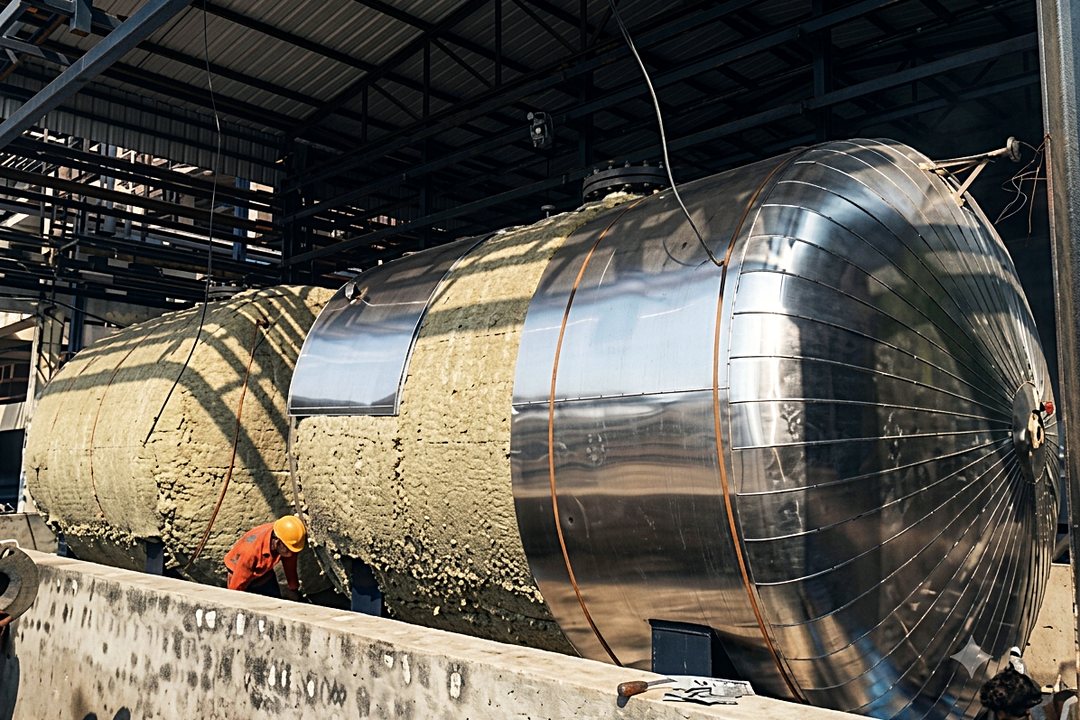
Large horizontal process vessel being insulated and clad

"Insulation" describes three quite different engineering problems that happen to use similar-looking materials. Treating them as one is how specifications go wrong.

Hot service: managing heat that wants to leave#

On a hot line the driving force is straightforward. Heat moves from the process to the atmosphere, and insulation slows it down.

The decisions are about temperature capability, thickness against a heat-loss or surface-temperature target, and whether the finish will survive thermal cycling. That last one catches people out: a system that is dimensionally fine at ambient can work its joints open after a few hundred heat-up and cool-down cycles.

Personnel protection is a separate calculation from heat conservation, and it usually governs. A thickness that is economically optimal for energy may still leave a surface hot enough to burn someone who steadies themselves against it.

Cold service: managing moisture that wants to get in#

On a cold line, heat flow is the smaller half of the problem.

The real driver is water vapour. Warm ambient air holds moisture; a cold surface condenses it. If vapour can migrate through the insulation to a surface below dew point, it condenses inside the system — where it destroys the thermal performance and starts corroding the pipe, quietly, with no external sign until the cladding comes off years later.

That makes the vapour barrier the primary component, not an accessory. A cold system with excellent insulation and a discontinuous vapour barrier will underperform a mediocre system with a continuous one.

In practice, continuity is a detailing problem:

  • Every joint sealed, not merely overlapped
  • Vapour stops at intervals, so a single breach cannot wet the whole run
  • Supports designed so the barrier passes through without being punctured
  • Terminations at valves, flanges and instruments closed properly rather than tucked in

Cryogenic service: everything, harder#

Cryogenic duty takes each cold-service problem and increases it.

Contraction is significant. A line running at cryogenic temperature is measurably shorter than the same line at ambient. The system has to accommodate that movement, repeatedly, without the joints opening.

Vapour drive is severe. The temperature difference across the insulation is far larger, so the pressure pushing moisture inward is far greater. A barrier detail that is adequate on a chilled-water line is not adequate here.

Failure is visible and immediate. Ice on the outside of the cladding is not a cosmetic issue; it means the system is already wet, and the wet part is generally larger than the iced part.

Where specifications typically go wrong#

The most common problem is not the wrong material. It is the right material with the wrong detailing:

  1. Treating the vapour barrier as a wrap rather than as a continuous envelope with designed terminations.
  2. Ignoring supports. A support that bridges the insulation is a thermal bridge and, on cold service, a condensation site.
  3. Leaving the last two per cent unfinished. Valves, flanges and small-bore branches are fiddly, get deferred, and end up as the permanent weak point.
  4. Inspecting only at the end. Once cladding is on, the layer doing the work cannot be seen. Inspection has to be staged.

The practical takeaway#

Before selecting anything, answer: what is the service temperature, is the surface above or below ambient dew point, and how much movement is there between the two states?

Those three answers determine whether you are solving a heat problem, a moisture problem, or both at once — and everything else follows from that.

If you have a scope you would like assessed, talk to us.

Keep reading

All insights