Insulation

Why cladding is the part of an insulation system that fails first

The insulation is rarely what goes wrong. It is the metal over the top of it — and almost always the detailing rather than the material.
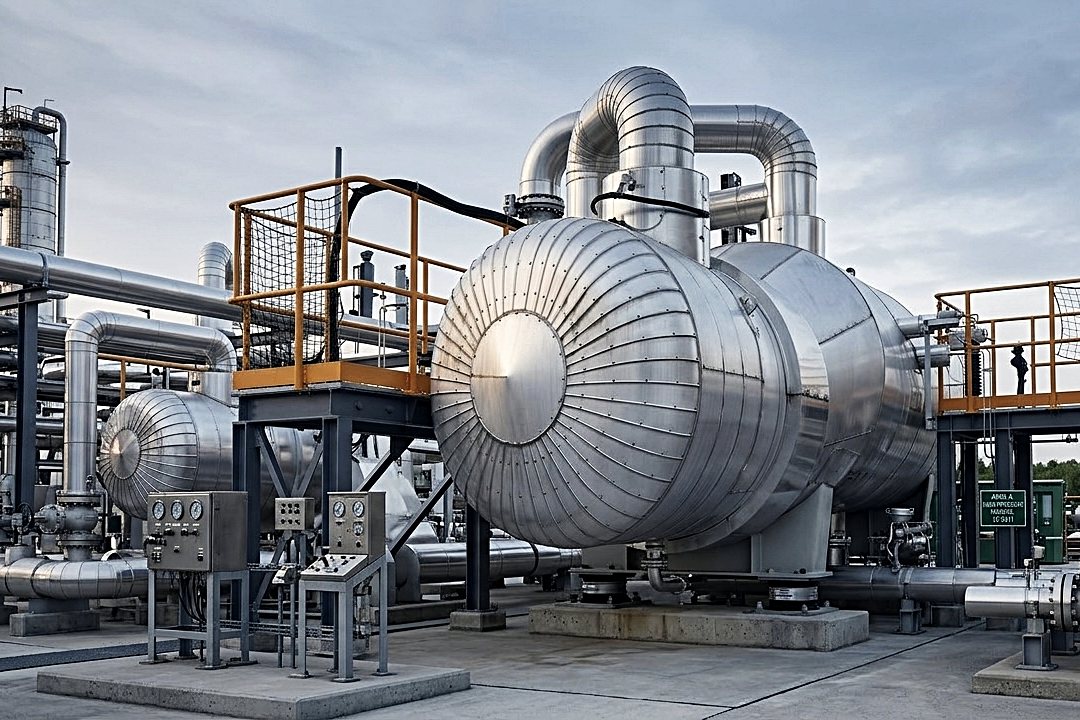
Clad and insulated process vessel and pipework at a refinery

Strip the cladding off a fifteen-year-old insulated line and the story is usually the same. The insulation is intact for most of its length, then soaked in three or four places, with corrosion on the pipe underneath each wet patch.

Those patches are never random. They sit under a lap facing the wrong way, a termination that stopped short, or a screw driven through the crown of a corrugation.

Cladding is a water-shedding system#

It is easy to think of cladding as protection — armour over the insulation. It is more useful to think of it as a roof: a set of surfaces arranged so that water always travels away from the system, never into it.

Once framed that way, most failures become obvious in advance.

Lap direction#

On a vertical run, upper sheets lap over lower ones. Reverse that and every joint becomes a funnel. It is the single most common defect, and it is nearly always the result of working bottom-up without thinking about which way water runs.

On horizontal runs, the longitudinal joint belongs at the side or underneath, never on top.

Terminations#

Wherever the system stops — at a flange, a support, a piece of equipment, a change of insulation type — water has an opportunity. A termination has to be closed off deliberately: a proper end cap, a bevelled finish that sheds outward, and a seal that is doing a secondary job rather than the primary one.

If the sealant is the only thing keeping water out, the detail is already wrong. Sealant has a service life. Geometry does not.

Fixings#

Screws go through the valley of a corrugation, not the crown. A fixing on the crown sits in the path of running water and relies entirely on its washer.

On cold systems, fixings should not penetrate the vapour barrier at all. Where they must, the penetration is sealed and backed.

Penetrations#

Every instrument tapping, support and branch is a hole cut in the roof. Each needs a formed collar that laps over the main sheet, in the direction water travels.

Collars cut on site with tin snips and closed with mastic are exactly the details that appear in the wet patches fifteen years later.

Why appearance is a real specification#

On pharmaceutical plant, and anywhere clients and auditors walk the site, cladding finish is part of the deliverable. That is not vanity.

Consistent lap direction, aligned banding, and clean penetrations are visible evidence about the invisible work. A crew that got the laps right is generally a crew that got the vapour barrier right, because both come from the same habit of thinking about where water goes.

Inspection: what to actually look at#

When walking a completed system:

  • Stand back and look at lap direction along a whole vertical run. Errors are obvious at ten metres and invisible at one.
  • Check the terminations, not the middle. The middle is almost always fine.
  • Look at every penetration. Is there a formed collar, and does it lap the right way?
  • Look underneath horizontal runs. Longitudinal joints on top are a defect you can only see from below.
  • On cold systems, look for staining or ice near supports — the first evidence of a bridged or punctured barrier.

None of that needs instrumentation. It needs someone who knows which four things to look at.

If you have a system that is not performing the way it should, get in touch.

Keep reading

All insights