Healthcare Engineering

Lead lining for diagnostic imaging: what a compliant installation involves

A shielded room is a specified quantity, not a lined one. The failures are almost always at the interruptions — penetrations, frames, and the gap above the ceiling.
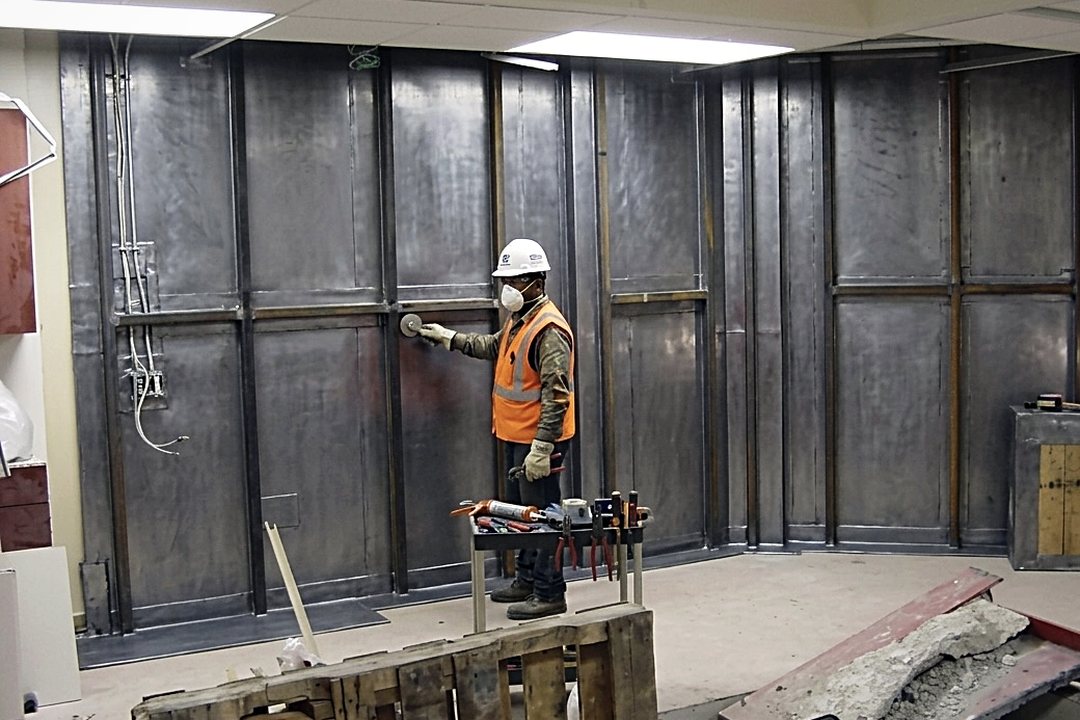
Technician installing lead sheet lining on the wall of a diagnostic imaging room

A radiation-shielded room is not "lined with lead". It is lined with a specific lead equivalence, at specific locations, derived by a physicist from the equipment, the workload, and the occupancy of every adjacent space.

The installer's job is to realise that specification exactly and to prove they did.

The specification comes first#

Before any material arrives, a radiation physicist produces a shielding design that accounts for:

  • The equipment and its maximum output
  • Expected workload — examinations per week, not the theoretical maximum
  • Occupancy of every adjacent space, including the floor above and below
  • Distance from the source to each barrier

The result specifies a lead equivalence for each surface. Those figures usually differ: the primary barrier behind the tube is not the same as the corridor wall.

An installer who applies one thickness everywhere has either overspent significantly or built a room that will fail its survey.

The lead is not what fails#

Sheet lead is a well-understood material, correctly manufactured and correctly specified. Installations do not fail because of it. They fail at the interruptions.

Joints#

Sheets must lap, not butt. A butt joint is a straight-line gap through the shielding — theoretically a hairline, practically a leak path the survey will find.

Fixings#

Every fixing through lined board is a hole through the shielding. Each needs a backing patch. Skip that on a wall with two hundred fixings and the barrier is perforated.

Service penetrations#

This is the big one. Electrical back-boxes, conduit, data cabling, ducting and medical gas all pass through shielded walls.

If they are formed before lining, the shielding is detailed around them. If they are cut after, someone has drilled through a finished barrier — and generally not told anyone.

The sequencing fix is simple and non-negotiable: coordinate with the electrical and HVAC trades, get every penetration located and formed first, then line.

Doors and viewing windows#

A door is a hole in the wall with a shielded panel in it. The lining must overlap the frame so there is no straight-line path through the gap. Leaded glass has to match the surrounding lead equivalence and be installed with the same overlap discipline.

Above the ceiling#

The defect that catches the most rooms. A wall is lined to the suspended ceiling and stops. Above that line there is an open void continuous with the next room, and radiation does not respect ceiling tiles.

The specification will state the height. It is almost always higher than the visible wall.

Documentation is part of the deliverable#

Once the room is finished the shielding is invisible. The record is the only evidence.

A proper handover package contains:

  • Material certificates confirming the lead equivalence supplied
  • As-installed drawings showing what went where
  • Photographic records taken before close-up, at every stage
  • Detail records for penetrations, frames and glazing

The photographs matter more than they sound. When a commissioning survey finds an anomaly, the difference between a targeted repair and opening the whole room is whether someone photographed the wall before boarding it.

A short pre-close-up checklist#

  1. Does the installed lead equivalence match the physicist's figure for each surface?
  2. Are all joints lapped, with the lap dimension the specification requires?
  3. Is every penetration formed, sealed and backed?
  4. Does the lining carry to the specified height above the ceiling line?
  5. Do the door frame and viewing panel overlap correctly?
  6. Is every wall photographed before it is boarded?

If you are planning an imaging installation, talk to us early — the coordination decisions that matter are made before anyone orders material.

Keep reading

All insights
Commercial induction cooktop unit in stainless steel
Kitchen Engineering

Induction versus flame in institutional kitchens

At a few thousand covers a day, the argument stops being about cooking preference and becomes one about ventilation load, ambient temperature and…
3 min read